
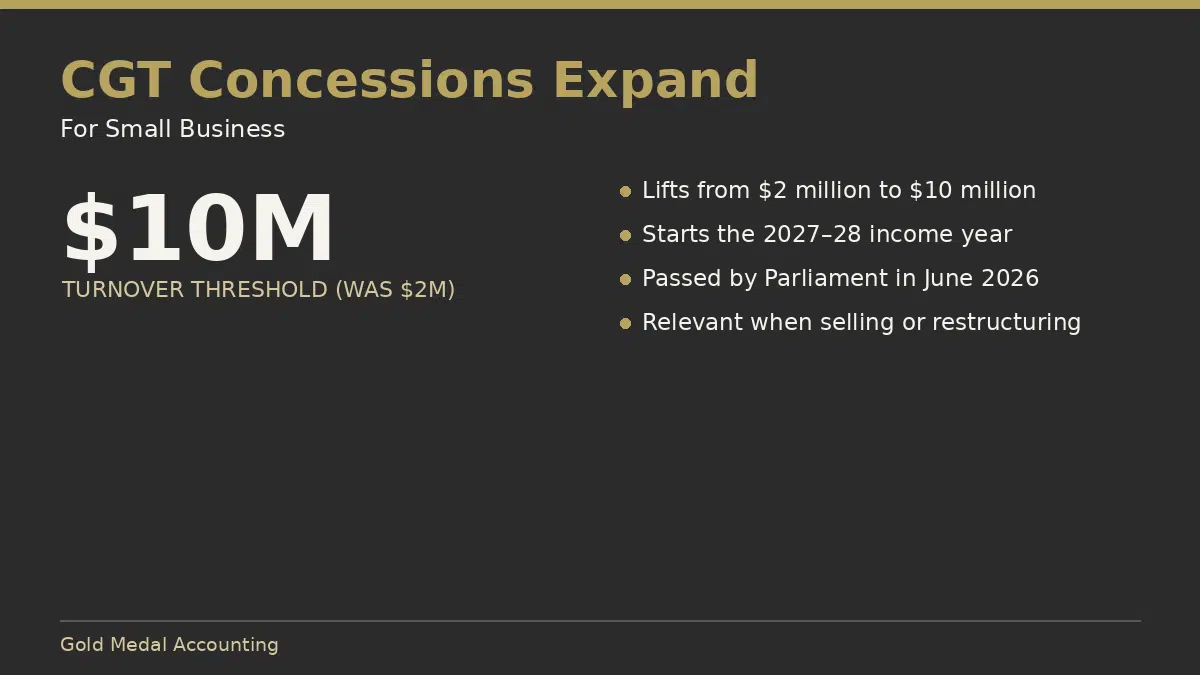
If your business turns over more than $2 million a year, you’ve probably assumed the small business capital gains tax concessions were out of reach for you — even if you sell the business itself, not just an asset inside it. That’s about to change. Legislation passed by Parliament in June 2026 will lift the turnover threshold for one of the four small business CGT concessions from $2 million to $10 million, starting from the 2027–28 income year. It’s a genuinely significant shift for Gold Coast business owners who are getting close to selling up, restructuring, or bringing in new investors, and the lead time before it takes effect makes now the right time to start planning around it.
Own or run a business on the Gold Coast?
We are a family-run business accountant on the Gold Coast, based in Burleigh Waters. Book a business discovery meeting, a first conversation to see whether we are the right fit for your business. We confirm the scope and quote before we start.
Questions about this? Talk to Bradley Witham, Chief Financial Officer at Gold Medal Accounting.
The Four Small Business CGT Concessions, Recapped
Under the existing rules, a business (or its owners) can access up to four separate CGT concessions when they sell an active business asset, provided they pass the basic conditions — including the active asset test and a turnover or asset-value threshold:
- The 50% active asset reduction — an extra 50% reduction on top of any general CGT discount
- The retirement exemption — up to a lifetime limit, tax-free if you’re under 55 and put it into super
- The 15-year exemption — a full exemption if you’ve owned the asset 15+ years and are retiring or permanently incapacitated
- The small business rollover — lets you defer a gain if you acquire a replacement asset
To use any of these, a business currently needs to pass the $2 million aggregated turnover test, or alternatively the $6 million net asset value test, along with the active asset test. Aggregated turnover isn’t just your own revenue — it includes turnover from connected entities and affiliates, which catches out more business groups than owners often expect.
What Changes From 1 July 2027
From the income year that includes 1 July 2027, the turnover threshold for the 50% active asset reduction specifically rises from $2 million to $10 million aggregated turnover. Treasury estimates this brings the vast majority of Australia’s active small businesses within reach of that concession for the first time. Importantly, the other three concessions — the retirement exemption, the 15-year exemption and the small business rollover — are not changing. They keep the existing $2 million turnover / $6 million net asset value tests, so a business with turnover above $2 million will gain access to the active asset reduction but not automatically to the other three.
- Applies from the income year including 1 July 2027 — not retrospectively, and not immediately
- Only the 50% active asset reduction threshold moves, from $2 million to $10 million turnover
- The retirement exemption, 15-year exemption and rollover keep the $2 million / $6 million tests
- The active asset test still applies — the asset must be genuinely used in carrying on the business
- Aggregated turnover still includes connected entities and affiliates
Why It’s a Bigger Deal Than It Sounds
The active asset reduction is the concession that stacks on top of the general 50% CGT discount already available to individuals and trusts on assets held longer than 12 months. Used together, a business owner who qualifies for both can reduce an assessable capital gain by up to 75%, before even considering the retirement exemption or rollover. For a business currently turning over, say, $4 million or $7 million — comfortably over today’s $2 million cut-off but under the new $10 million mark — that’s the difference between paying tax on the full discounted gain and cutting it by another half again when the business is eventually sold.
What Gold Coast Business Owners Should Do Now
Because the change doesn’t start until the 2027–28 income year, there’s a genuine planning window rather than a rush. That’s useful, but it also means decisions made well before the effective date — about structure, timing of a sale, or how a group of connected entities is organised — can materially affect whether you get the benefit of the wider threshold when the time comes.
- Work out your aggregated turnover properly, including any connected entities or affiliates, rather than just your own trading entity’s revenue
- If you’re planning to sell a business asset or the business itself, consider whether timing the sale before or after 1 July 2027 changes your position
- Review your business structure now if you’re sitting just above the current $2 million threshold — the extra runway before 2027 is useful
- Don’t assume the other three concessions apply just because the active asset reduction now might — each still has its own turnover or net asset test
Gold Medal Accounting is a family-run firm of Gold Coast accountants in Burleigh Waters, a few minutes from Burleigh Heads.
Need Help Planning Ahead?
Whether you’re weighing up the timing of a business sale, unsure how aggregated turnover applies to your group structure, or just want to understand what this means for your long-term exit plans, the team at Gold Medal Accounting can help you work through it. Get in touch and we’ll help you plan ahead of the 2027 changes, not just react to them.