
A director penalty notice can make you personally liable for your company’s unpaid PAYG withholding, GST or superannuation guarantee charge, and in 2026 the ATO is issuing them at a rate few directors are prepared for. The ATO’s own performance auditor has confirmed what many advisors already suspected: small business collectable debt has jumped 118% since 2018-19 to sit at $35.9 billion, and the Tax Office is now under formal pressure to close that gap fast.
Technical review by Lynn Witham, Senior Accountant, Director & Registered Tax Agent — last updated 2 November 2026.
Own or run a business on the Gold Coast?
We are a family-run business accountant on the Gold Coast, based in Burleigh Waters. Book a business discovery meeting, a first conversation to see whether we are the right fit for your business. We confirm the scope and quote before we start.
Questions about this? Talk to Bradley Witham, Chief Financial Officer at Gold Medal Accounting.
What’s driving the crackdown
A 2026 performance audit by the Australian National Audit Office (ANAO) found the ATO’s approach to small business debt is only partly effective. Small business collectable debt now sits at a 36.8% ratio against the ATO’s own 7.5-8% benchmark – more than four times the target. The ANAO made eight recommendations, including that the ATO set clear volume targets rather than relying on ratios alone. The ATO has agreed to the findings and set a new target of bringing that ratio down to 6% by June 2027, with Second Commissioner David Allen saying the office will carefully consider the recommendations as part of ongoing improvement. The ANAO published its full findings in a report.
Director Penalty Notices, in plain English
- Non-lockdown DPN – issued when your business has lodged its BAS and other returns on time but hasn’t paid the debt. The ATO can recover the penalty from you 21 days after it issues the notice. In that window the penalty can be remitted if the company pays the debt in full, an administrator or small business restructuring practitioner is appointed, or the company begins to be wound up. If none of these happens in time, you remain personally liable. A payment plan on its own does not remit the penalty.
- Lockdown DPN — issued when your PAYG withholding or GST wasn’t reported to the ATO within three months of its due date (income tax returns aren’t a DPN debt type, so a late income tax return alone doesn’t trigger this). As with any DPN, the ATO generally can’t start recovery action until 21 days after issuing the notice — but the remission options are far narrower: appointing an administrator, entering Small Business Restructuring or winding up the company won’t remit the penalty, and full payment of the debt is generally the only way out. The superannuation guarantee charge (SGC) has its own separate rule: report it by the SGC due date, or the only way to remit the penalty is paying the SGC debt in full — a payment plan alone won’t remit it.
- Covers three debt types: PAYG withholding, GST (including net GST), and the superannuation guarantee charge (SGC).
Source: ATO, Director penalties. The right option depends on when the debt was reported, so get advice as soon as a notice arrives.
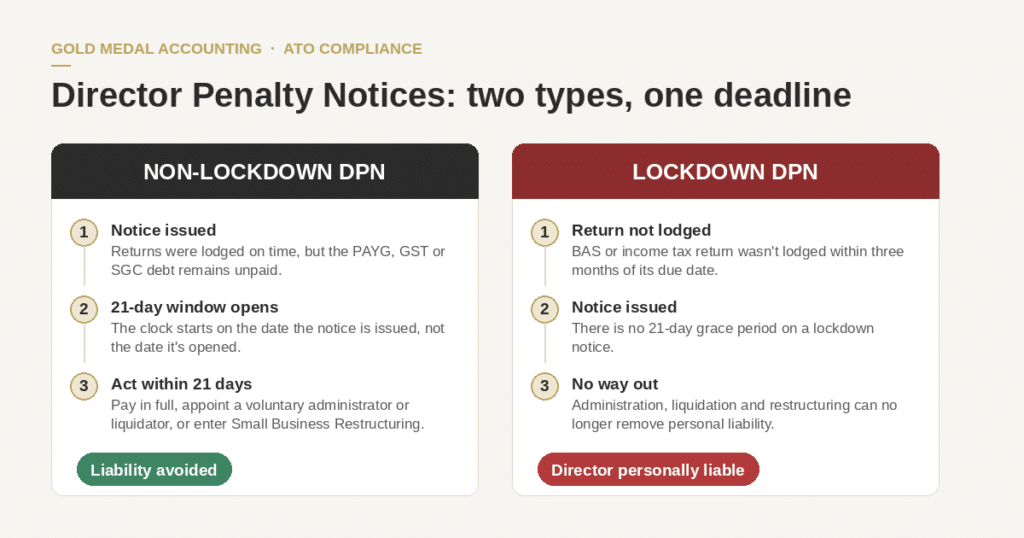
What to do in the 21 days after a notice arrives
A director penalty notice is time-sensitive. Here is a practical checklist for the 21-day window.
- Note the date. The 21 days starts on the day the ATO posts the notice or leaves it at your ASIC-registered address, not the day you open it. Work out the last day and put it in your diary.
- Get advice straight away. Call your accountant or us on the day the notice arrives. The options depend on timing, and some of them can only be used within the 21 days.
- Find out which type of notice it is. Check when the PAYG withholding or GST was reported (within three months of the due date or later), and whether any super was reported by the super guarantee charge due date. That decides which options you have.
- Choose an option that remits the penalty. If the debt was reported on time, the company can pay it in full, appoint an administrator or small business restructuring practitioner, or begin to be wound up. If it was reported late or not at all, paying the company debt in full is generally the only way. A payment plan on its own does not remit the penalty.
- Keep proof. Keep dated evidence of the payment or appointment, and confirm in writing with the ATO that the penalty has been remitted.
- Check every director. Each director gets their own notice and is liable for the same amount. A payment by the company reduces everyone’s liability, but you cannot rely on a co-director or adviser to have dealt with it.
- Consider a defence. You may have one if you took no part in managing the company because of illness or another acceptable reason, or took all reasonable steps to get the debt paid or the company into administration or winding up. It must be put to the ATO in writing and it is hard to succeed, so get advice first.
- Check what is still outstanding. Lodge any overdue BAS, PAYG withholding and super reports so the debt figure is accurate and the ATO has no reason to estimate amounts.
If none of these steps is taken within the 21 days, the ATO can start recovery. It can offset your tax refunds, issue garnishee notices or take legal action, and you remain personally liable even after the company is deregistered. Source: ATO, Director penalties (updated 16 April 2026). This is general information only. If you have received a notice, call us on 07 5669 8922 today.
Why this matters more than it used to
The numbers show the ATO isn’t just tightening policy, it’s actively enforcing it. The Tax Office issued 84,529 DPNs in 2024-25, a 136% jump on the year before, chasing roughly $5.5 billion in unpaid PAYG, GST and super. The ATO’s own Deputy Commissioner has flagged that more DPNs, and more insolvencies, are on the way.
This director penalty notice surge is not a blip. The scale of enforcement has drawn scrutiny of its own: the Tax Ombudsman announced a formal review of the ATO’s DPN practices in 2026, after concerns that some notices were being issued without enough regard for a director’s individual circumstances. That review is a reason for the ATO to be more careful, not a reason for directors to assume a notice won’t arrive. And the debt behind these notices keeps getting more expensive to carry, now that ATO interest charges are no longer tax deductible.
What Gold Coast business owners should do about it
- Check your lodgement status first — a lockdown DPN is triggered by late PAYG withholding or GST reporting, not by an overdue income tax return, so keep your BAS lodgments within three months of their due date.
- If a DPN lands, don’t sit on it – the 21-day clock on a non-lockdown notice starts the day it’s issued, not the day you open the mail.
- Know your options before you need them – for a non-lockdown DPN, paying in full, restructuring, administration or liquidation within the 21-day window all remit personal liability; for a lockdown DPN, full payment is generally the only way out.
- Talk to us before the ATO does the talking – a payment plan or Small Business Restructuring negotiated early is a very different conversation to one started after a notice has already issued.
- Don’t assume silence is safety – with DPN numbers up sharply year-on-year, an overdue balance that’s been quiet for months is exactly the kind of debt the ATO is now targeting.
Gold Medal Accounting is a family-run firm of Gold Coast accountants in Burleigh Waters, a few minutes from Burleigh Heads.
Need help?
If your business is carrying ATO debt, or you’re worried a Director Penalty Notice could be on its way, get in touch with the team at Gold Medal Accounting. We’ll help you work out where you stand, what your options are, and how to deal with the ATO from a position of control rather than crisis. Contact us or call 07 5669 8922 to talk through your situation, especially if you’re inside the 21-day window a DPN gives you to act.