
Quick answer: No. The ATO’s General Interest Charge (GIC) and Shortfall Interest Charge (SIC) incurred on or after 1 July 2025 are no longer tax deductible. Interest charged before that date is still deductible in the year it was incurred. GIC is 11.51% a year for October–December 2026.
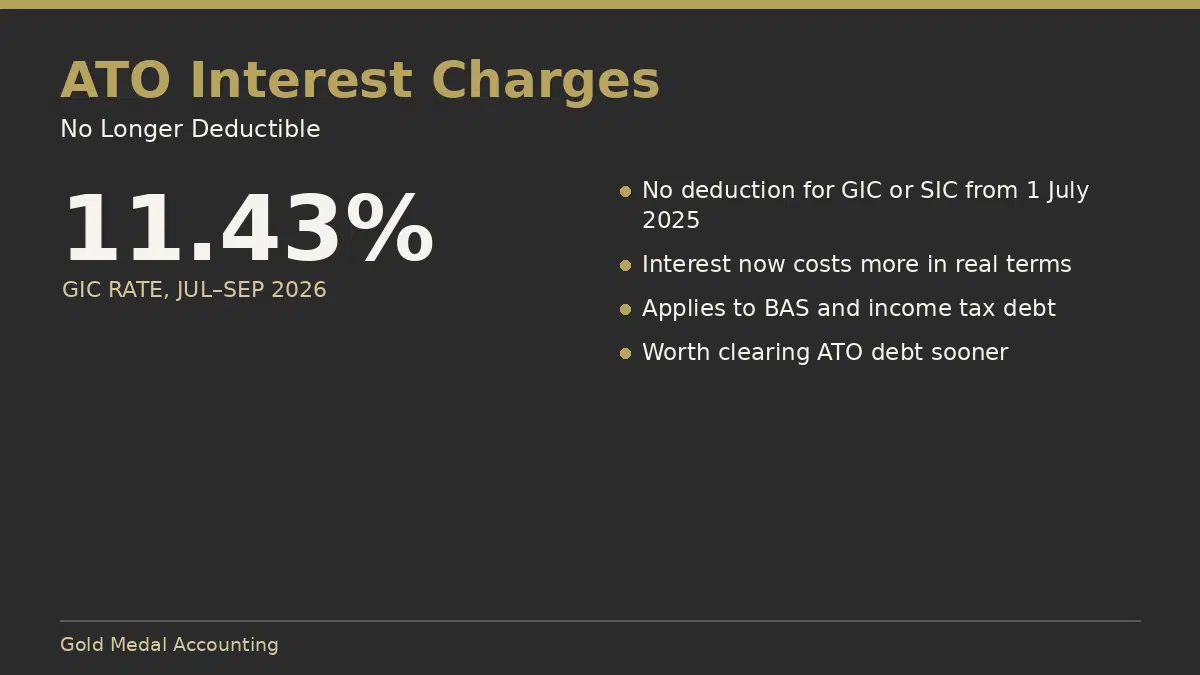
If your business has ever let a BAS or income tax debt sit with the ATO for a while, you already know the interest adds up. What’s changed is that this interest now costs twice as much in real terms — because for any General Interest Charge (GIC) or Shortfall Interest Charge (SIC) incurred on or after 1 July 2025, you can no longer claim a tax deduction for it. With the GIC currently running at 11.51% per annum for the October–December 2026 quarter (up from 11.43% for July–September), that’s a meaningful hit for any Gold Coast business carrying ATO debt into this tax season.
Own or run a business on the Gold Coast?
We are a family-run business accountant on the Gold Coast, based in Burleigh Waters. Book a business discovery meeting, a first conversation to see whether we are the right fit for your business. We confirm the scope and quote before we start.
Questions about this? Talk to Bradley Witham, Chief Financial Officer at Gold Medal Accounting.
What actually changed
Under the Treasury Laws Amendment (Tax Incentives and Integrity) Act 2025, the ATO’s General Interest Charge and Shortfall Interest Charge are no longer deductible for income years starting on or after 1 July 2025. The change applies broadly – to individuals, sole traders, companies and trusts alike – and covers anyone who has previously been claiming this interest as a deduction on their tax return.
Importantly, the change only bites on interest that accrues from 1 July 2025 onward. If you were charged GIC or SIC before that date, it remains deductible in the year it was incurred, even if you’re only getting around to lodging that return now.
GIC and SIC, in plain English
- General Interest Charge (GIC) – charged daily on a compounding basis on any tax debt (income tax, GST, PAYG withholding, the super guarantee charge and more) that isn’t paid by its due date.
- Shortfall Interest Charge (SIC) – charged when an amended assessment shows you underpaid tax in an earlier year, running from the original due date until the amended assessment issues.
- Both rates are set quarterly by the ATO. For the October–December 2026 quarter, GIC sits at 11.51% per annum (it was 11.43% for July–September).
Why this matters more than it used to
Before 1 July 2025, a business paying GIC could at least offset some of the pain with a deduction, which lowered the real cost of carrying ATO debt. With that deduction gone, the full interest rate now comes straight out of after-tax profit. As an example, $50,000 of overdue BAS debt sitting with the ATO for a full year at the current rate works out to roughly $5,700 in interest – all of it now non-deductible, where a portion would previously have reduced your tax bill.
Advisors around the country are increasingly describing ATO debt as one of the most expensive forms of finance available to a small business – more costly, once you factor in the lost deduction, than most bank overdrafts, lines of credit or business loans.
What Gold Coast business owners should do about it
- Get on top of overdue lodgements and payments now, rather than letting a balance sit and compound at 11.51%.
- If you’re on an ATO payment plan, check whether a business loan or line of credit with deductible interest would now work out cheaper than carrying the ATO debt.
- Build BAS, PAYG and super due dates into your cash flow forecasting so you’re not caught relying on the ATO as short-term finance.
- If you’ve received an amended assessment, check the date SIC started accruing – anything before 1 July 2025 is still deductible.
- Don’t assume a payment plan is your only option – remission requests and refinancing are both worth exploring on a case-by-case basis.
We are accountants on the Gold Coast, based at Treetops Square in Burleigh Waters, and we look after tax returns and business accounting for clients right across the Coast.
Need help?
If your business is carrying ATO debt, or you’re not sure how this change affects a return we’re preparing for you, get in touch with the team at Gold Medal Accounting. We’ll help you weigh up your options – whether that’s restructuring finance, requesting a remission, or simply tightening up your compliance so it doesn’t become an issue again – before the interest keeps compounding. Contact us or call 07 5669 8922 to talk through your situation.