
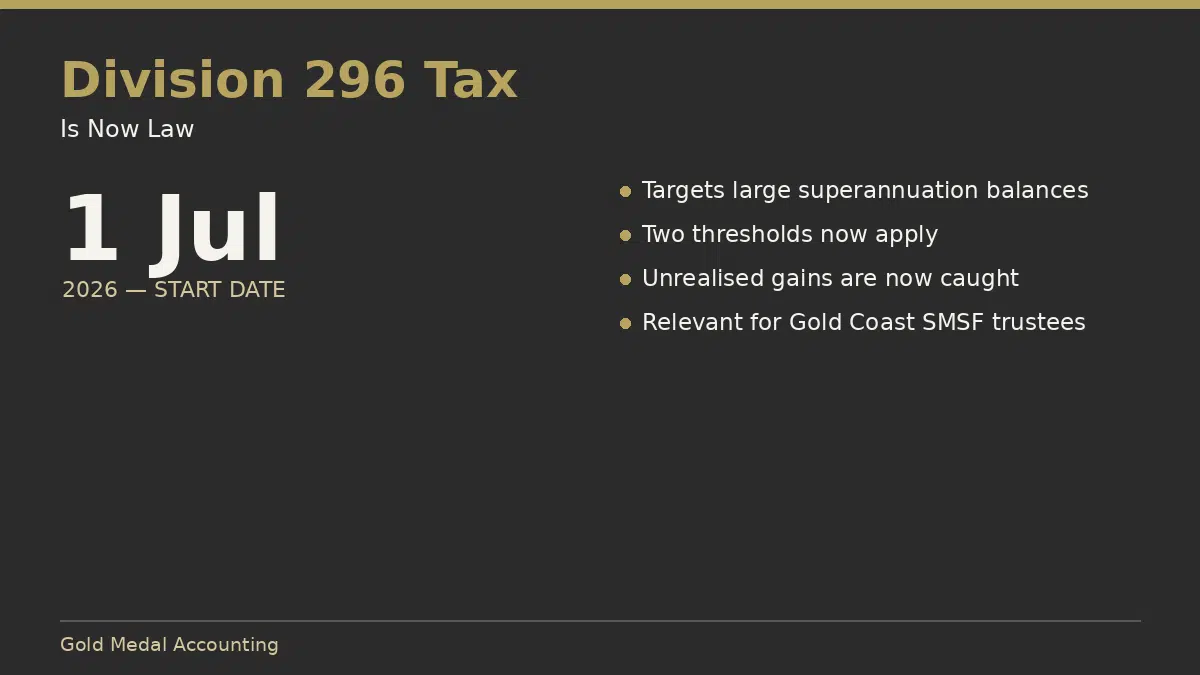
Division 296 tax officially started on 1 July 2026, and it’s already changing the game for anyone with a large superannuation balance — including plenty of Gold Coast business owners who’ve built wealth inside an SMSF. Two months in, we’re still fielding questions about who it actually affects and what it means in practice, so here’s the plain-English version.
Own or run a business on the Gold Coast?
We are a family-run business accountant on the Gold Coast, based in Burleigh Waters. Book a business discovery meeting, a first conversation to see whether we are the right fit for your business. We confirm the scope and quote before we start.
Questions about this? Talk to Bradley Witham, Chief Financial Officer at Gold Medal Accounting.
What Is Division 296 Tax?
Division 296 is a new, additional tax on the earnings attached to large superannuation balances. It sits on top of the tax your fund already pays — it doesn’t replace it. If your Total Superannuation Balance (TSB) is under $3 million, none of this applies to you. If it’s over $3 million, a slice of your fund’s earnings now attracts extra tax.
This has been years in the making, and the version that finally passed Parliament in March 2026 is meaningfully different — and fairer — than the original 2023 proposal.
The Two Thresholds
There are two tiers, both indexed to inflation over time:
- $3 million (the “Large Super Balance Threshold”) — earnings attributable to the portion of your balance above this get an extra 15% tax, on top of the standard 15% fund tax rate. That’s an effective 30% on that slice.
- $10 million (the “Very Large Super Balance Threshold”) — earnings attributable to the portion above this get a further additional 10%, taking the effective rate to 40% on that slice.
Only the earnings tied to the excess above each threshold are taxed at the higher rate — not your entire balance, and not your entire earnings.
The Big Change: Unrealised Gains Are Out
The original 2023 design would have taxed unrealised gains — meaning you could owe tax on paper growth you hadn’t actually banked yet, a particular problem for SMSFs holding property or business real property that can’t easily be sold to fund a tax bill. That approach copped heavy criticism, and it didn’t survive.
The law that actually passed uses a realised earnings approach instead: super funds report actual, realised earnings using an approved methodology, not year-to-year valuation swings. It’s a much more workable outcome, particularly if your SMSF holds property, business premises, or other illiquid assets.
Why SMSF Trustees Should Pay Attention
If you run an SMSF and your fund (or your combined balance across all your super) sits near or above $3 million, this now needs to be part of your annual planning — not something you deal with after the fact. It’s especially worth a look if:
- Your fund holds property, including business real property leased back to your own company
- You’ve been making large concessional or non-concessional contributions to build super rather than other assets
- You’re approaching retirement and consolidating balances
- You share an SMSF with a spouse — remember the $3 million threshold applies to each member’s own Total Superannuation Balance, not the fund’s combined balance, so one of you can be affected even if the other isn’t
When You’ll Actually Feel It
Division 296 tax applies from the 2026–27 income year, which we’re already in. But the ATO won’t issue the first assessments until the second half of the 2027–28 income year — so there’s a lag between when the tax starts accruing and when the bill actually lands. That gap is useful: it gives you time to plan for the cash flow impact rather than being surprised by it.
What Gold Coast Business Owners Should Do Now
- Check your Total Superannuation Balance across every fund you hold, not just your SMSF
- Review liquidity, especially if your SMSF holds property or business real property — you don’t want a tax bill you can’t easily fund
- Reconsider contribution strategy if you’re actively growing a balance that’s already close to $3 million
- Factor Division 296 into retirement and succession planning, particularly if you’re planning to wind up or restructure your SMSF in the next few years
- Wait for final ATO guidance on the approved earnings methodology before making major structural changes — the mechanics are still being finalised
Need Help Working Out Where You Stand?
Division 296 is one of those changes where the detail matters — how it interacts with your specific fund structure, your contribution history, and your broader retirement plans is different for every client. If you’re not sure whether it affects you, or you want a proper look at your SMSF’s position before the first assessments arrive, get in touch with the team at Gold Medal Accounting. We can walk through your numbers and flag anything worth acting on now rather than later.
Gold Medal Accounting is a family-run Gold Coast accountant in Burleigh Waters, helping individuals and businesses with tax, BAS and advice.