
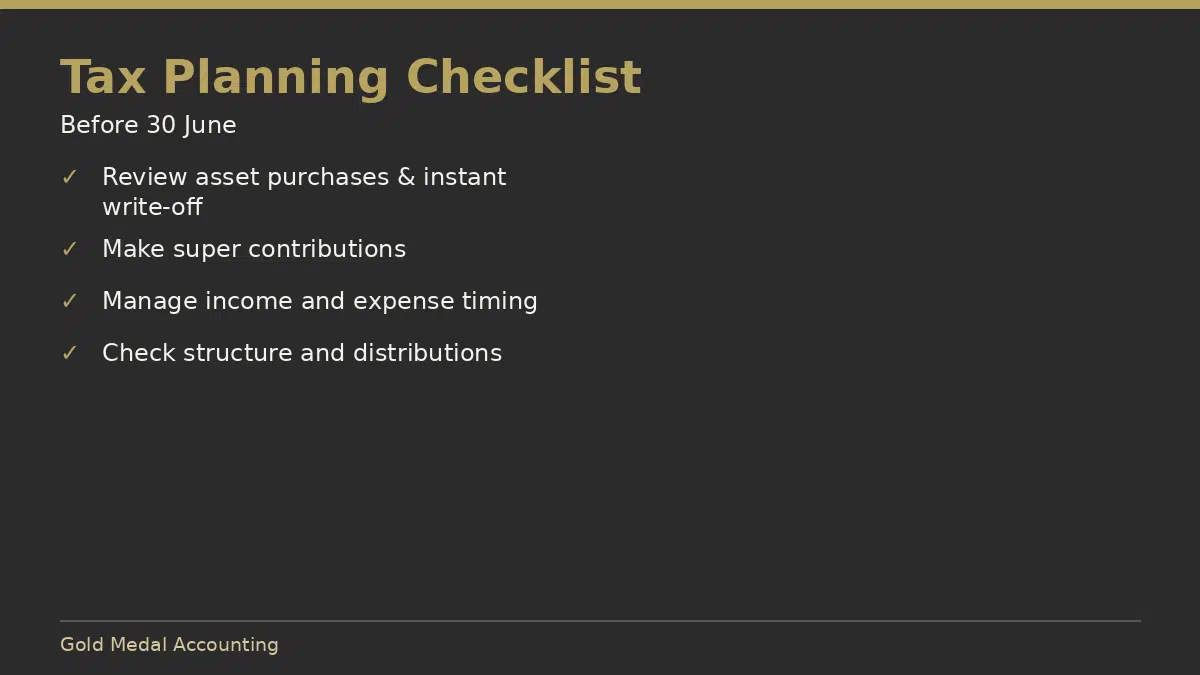
The best tax planning happens before 30 June, not after it. Once the financial year closes, most of your options close with it — what’s left is simply reporting what already happened. Here’s what’s worth reviewing before the year ends, not the week after.
Technical review by Lynn Witham, Senior Accountant, Director & Registered Tax Agent — last updated 19 September 2026.
Own or run a business on the Gold Coast?
We are a family-run accounting firm in Burleigh Waters. Book a business discovery meeting, a first conversation to see whether we are the right fit for your business. We confirm the scope and quote before we start.
Questions about this? Talk to Bradley Witham, Chief Financial Officer at Gold Medal Accounting.
Asset purchases and the instant write-off
The $20,000 instant asset write-off has now been made a permanent measure, with no expiry date, for businesses with aggregated turnover under $10 million. Each eligible asset costing less than $20,000 (GST-exclusive) can be written off immediately in the year it’s first used or installed ready for use, rather than depreciated over several years. If you’re planning equipment or vehicle purchases anyway, timing them before or after 30 June can make a real difference to this year’s tax bill — worth deciding deliberately rather than by accident.
Superannuation contributions
Concessional super contributions need to actually be received by your fund by 30 June to count in that financial year — a contribution processed on 30 June but not cleared until 1 July falls into the wrong year. If you’re planning to top up super for a tax deduction, get the payment moving well before the deadline, not on it.
Income and expense timing
- Review whether bringing forward deductible expenses, or deferring income where legitimately possible, makes sense for your situation this year.
- Write off genuinely bad debts before year-end so the deduction falls in the right period.
- Check stock on hand and write down obsolete or damaged inventory if your business carries stock.
Structure and distributions
If you operate through a trust, distribution resolutions generally need to be made and documented before 30 June — leaving this until your tax return is prepared months later is too late and can result in the trust’s income being taxed at the top rate. Companies should also review any director loans or related-party transactions before year-end, since these carry their own compliance requirements (Division 7A) if left unresolved.
The real value of planning early
None of this works well as a last-minute exercise. We run tax planning conversations with clients in April and May specifically so there’s still time to act on what we find — by the time we’re preparing your return in the new financial year, most of the year’s opportunities have already closed. For the current instant asset write-off threshold and other end-of-year rules, see the ATO’s simplified depreciation guidance.
Want a tax planning review before 30 June? Get in touch or call us on 07 5669 8922 — or read more about our tax planning and structuring advice, part of our wider business accounting services on the Gold Coast.
Looking for an accountant on the Gold Coast? Gold Medal Accounting is a family-run practice in Burleigh Waters.