
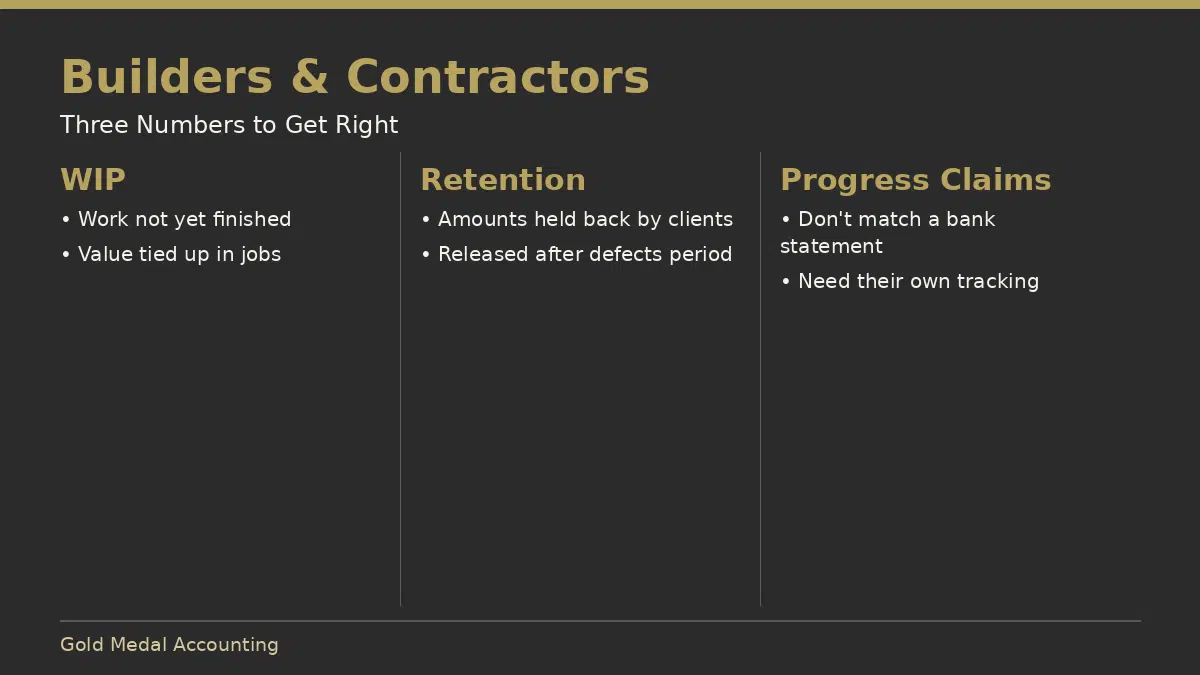
Construction and trade businesses run into accounting problems that most other industries never see — money tied up in jobs that aren’t finished, retention amounts held back by clients, and progress claims that don’t line up neatly with a monthly bank statement. Standard off-the-shelf bookkeeping struggles with all three unless it’s set up with the industry in mind.
Technical review by Lynn Witham, Senior Accountant, Director & Registered Tax Agent — last updated 19 September 2026.
Own or run a business on the Gold Coast?
We are a family-run accounting firm in Burleigh Waters. Book a business discovery meeting, a first conversation to see whether we are the right fit for your business. We confirm the scope and quote before we start.
Questions about this? Talk to Bradley Witham, Chief Financial Officer at Gold Medal Accounting.
Work in progress (WIP)
On a long job, you’re spending money on materials, labour and subcontractors well before you’re paid for the finished work. If your accounts only show income when an invoice is raised, a business can look far less profitable — or far more profitable — than it actually is at any given point in time, simply because of where a job sits in its cycle. Tracking work in progress properly means recognising the value of work completed but not yet billed, so your financial reports reflect the real state of every job, not just what’s been invoiced.
Retention amounts
Retention — the percentage a client holds back until practical completion or the end of a defects liability period — needs to be tracked separately from your normal debtors. It’s real money owed to you, but it often won’t land for months, sometimes over a year, after the rest of the job is paid. Businesses that don’t track retention separately tend to lose sight of how much cash is actually sitting out there, which makes cash flow forecasting far less reliable.
Progress claims
Progress claims need to be reconciled against the actual stage of each job, not just issued on a set schedule regardless of what’s been completed. Over-claiming ahead of the work done creates a liability you’ll need to unwind later; under-claiming ties up cash you’re entitled to. Good job costing — tracking materials, labour and subcontractor costs against each job individually, not just against the business as a whole — is what makes accurate progress claims possible.
Don’t forget the Taxable Payments Annual Report
Businesses in the building and construction industry that pay contractors for construction services generally need to lodge a Taxable Payments Annual Report (TPAR) each year, reporting those contractor payments to the ATO. It’s easy to overlook if your bookkeeping doesn’t tag contractor payments as they’re recorded through the year.
Setting your books up for the way you actually work
We work with builders, tilers, electricians and other trade businesses across the Gold Coast to set up job costing, WIP tracking and retention schedules that match how construction actually gets paid — not a generic chart of accounts that assumes every sale is a single, immediate transaction.
Want your books set up properly for job costing and progress claims? Get in touch or call us on 07 5669 8922 — or read more about our accounting services for tradies and contractors, part of our wider business accounting services on the Gold Coast.
Based in Burleigh Waters, Gold Medal Accounting is a family-run firm of Gold Coast accountants for individuals, property investors and businesses.