
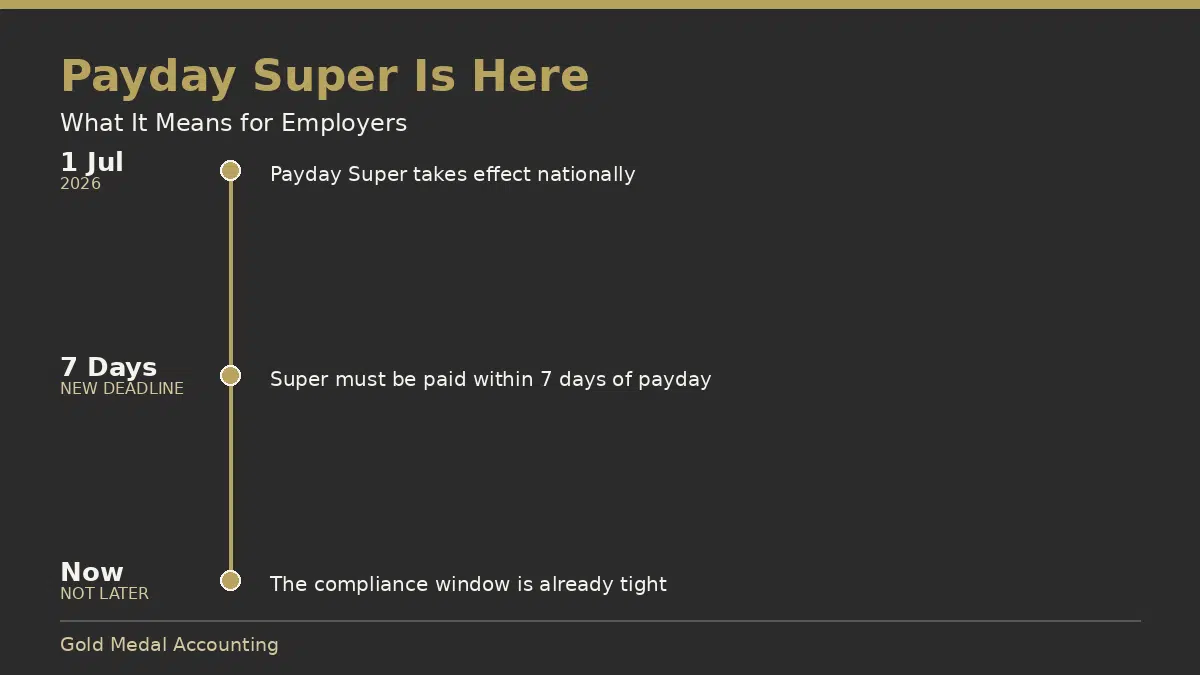
Payday Super took effect across Australia on 1 July 2026 — and if you run a business on the Gold Coast with even one employee, it has already changed how and when you need to pay superannuation. Four months in, we’re still fielding questions from local business owners who thought this was something to worry about “eventually.” It isn’t. It’s live now, and the compliance window is far tighter than it used to be.
What Is Payday Super?
Payday Super replaces the old quarterly super guarantee (SG) system. Instead of having until 28 days after the end of each quarter to pay your employees’ super, you now need to get it into their super fund within 7 business days of each payday. The SG rate itself hasn’t changed — it’s still 12% — but the calculation now applies to a broader measure called “qualifying earnings,” which we cover below.
The New 7-Day Payment Deadline
This is the change catching people out. If you run payroll weekly, fortnightly or monthly, super now has to land in your employees’ funds within a week of each pay run — not once a quarter. For many small businesses this means payroll and super processes that used to run on separate schedules now need to be tied together, which is as much a cash-flow question as it is a compliance one.
Longer Deadlines for New Staff, New Funds and Bonuses
Not every payment has to land within 7 business days. The ATO allows more time in a few situations:
- New employee, or a new fund for an existing employee: the first contribution has 20 business days after payday to reach the fund. After that, the normal 7 business days applies.
- Bonuses, commissions or back pay paid outside your normal pay cycle: the super is due within 7 business days after your next regular payday.
- Business days don’t include weekends or public holidays that apply across a whole state or territory.
Leave yourself a buffer. Payments through the New Payments Platform can arrive the same day, but some clearing houses take a few days to pass money on, and a fund has up to three business days to allocate or return a contribution (ATO: payment deadlines for Payday Super).
What Counts as “Qualifying Earnings” Now
Rather than the old “ordinary time earnings” measure, super guarantee is now calculated on “qualifying earnings” — a broader definition that also captures things like commissions and salary-sacrificed amounts. If your payroll software hasn’t been updated to reflect this, it’s worth checking with your payroll provider that the right figure is being used each pay run.
Overtime, fringe benefits, expense reimbursements and paid parental leave still aren’t qualifying earnings. There’s also still a ceiling: the maximum contribution base is now worked out per financial year, and for 2026-27 it’s $270,830 of qualifying earnings. Once an employee has been paid that much in the year, you can stop paying SG for them unless their award or agreement says otherwise (ATO: maximum contributions base).
Tougher — But Fairer — Penalties for Late Payments
If super reaches the fund late, the ATO now raises the super guarantee charge (SGC) itself rather than waiting for you to self-assess. The charge is made up of the unpaid super, notional earnings (interest at the general interest charge rate, compounding daily, instead of the old flat 10%) and an administrative uplift. The uplift starts at 60% of the shortfall and earnings, drops to 40% if you haven’t had an ATO-initiated assessment in the previous two years, and can be reduced further, to nil in some cases, if you make a voluntary disclosure early. A 25% choice loading (capped at $1,200 per notice period) can also apply if you don’t pay into the employee’s chosen fund.
The good news: SGC for paydays from 1 July 2026 is tax deductible, which it never was under the old rules. Interest on a late-paid charge and any late payment penalty still aren’t deductible, and paying late can’t reduce the charge to nil (ATO: what happens if you don’t pay super correctly). A smaller penalty is still a poor substitute for paying on time, especially now the ATO sees every pay run through Single Touch Payroll.
Single Touch Payroll Changes
From the first payday on or after 1 July 2026, each STP report needs to show every employee’s year-to-date qualifying earnings and year-to-date super liability, and it still has to be lodged on or before payday. For 2026-27 the ATO will accept ordinary time earnings while payroll software catches up, but from 1 July 2027 reports without both amounts will be rejected. Don’t report fringe benefits or expense reimbursements as qualifying earnings (ATO: STP reporting under Payday Super).
The Small Business Superannuation Clearing House Has Closed
If your business used the free Small Business Superannuation Clearing House (SBSCH) to pay staff super, that service ceased operating from 1 July 2026, with no extension. If you haven’t already moved to a commercial clearing house or a payroll system with built-in super payment, this is the one that needs sorting first — there’s no fallback option left.
The ATO’s First-Year Approach: Three Risk Tiers
Recognising that plenty of small businesses are still bedding down new payroll processes, the ATO has published a Practical Compliance Guideline (PCG 2026/1) setting out how it will prioritise compliance activity for the first year of Payday Super, running from 1 July 2026 to 30 June 2027. It doesn’t change the law or waive penalties, but it does tell you where the ATO is likely to look first:
- Low risk: the employer tried to make sufficient on-time contributions. Where a payment was late, the problem was corrected as soon as reasonably practicable and sufficient eligible contributions reached the relevant funds to clear the employees’ individual final SG shortfalls.
- Medium risk: the low-risk conditions are not met, but all employees’ individual final SG shortfalls are nil by 28 days after the end of the relevant quarter. Continuing quarterly payments can fall here; it is not the only situation covered.
- High risk: the employer does not meet the low- or medium-risk conditions, including where an individual final SG shortfall remains after that 28-day point.
These categories guide ATO compliance priorities; they do not extend the legal payment deadline or guarantee relief from the super guarantee charge. Late contributions can clear the contribution shortfall while a charge for notional earnings and an administrative uplift remains. The usual receipt timeframe is seven business days after payday, with specific longer periods in some circumstances.
Sitting in the medium tier isn’t a free pass, and it doesn’t protect you from an employee’s own claim under the Fair Work Act if their super hasn’t been paid on time. But it does give businesses genuinely transitioning their systems some breathing room while they get the timing right.
Key Date: 28 October 2026 (Now Passed)
The September 2026 quarter was the first one measured under Payday Super. Any super shortfalls from July to September needed to be cleared by 28 October 2026, 28 days after the quarter ended, to stay out of the ATO’s high-risk group. If you missed that date, pay any shortfall now and talk to us about a voluntary disclosure — the sooner you come forward, the better. The next checkpoint is the December quarter: shortfalls need to be cleared by 28 January 2027. Review payroll and super at the same time as you pull your BAS figures together rather than treating them as separate jobs.
Check a pay run: our free Payday Super due date calculator shows the exact date super has to reach the fund, including new employee and bonus rules and interstate public holidays.
What Gold Coast Businesses Should Do Now
- Confirm your payroll or clearing house solution can actually pay super within 7 business days of each pay run — not just calculate it correctly.
- Check that “qualifying earnings” (not just ordinary time earnings) is the figure being used to calculate the 12% SG amount.
- Build super into your weekly or fortnightly cash-flow planning rather than putting it aside for quarter-end.
- If you were still using the SBSCH, get a replacement clearing house set up immediately — this can’t wait for your next BAS.
- Review your last two pay runs to make sure super actually reached your employees’ funds within the new deadline, not just that it was calculated.
For wider payroll obligations, see our guide to STP and payroll compliance, or our payroll services.
Payday Super FAQs
Can I still pay super quarterly?
Not for earnings paid from 1 July 2026. The ATO’s first-year approach treats employers who keep paying quarterly as medium risk, and the super guarantee charge can still apply to each late payday.
Is the super guarantee charge tax deductible now?
Yes, for paydays from 1 July 2026. Charges for quarters before then still aren’t, and interest on a late-paid charge isn’t either.
What replaced the Small Business Superannuation Clearing House?
The ATO hasn’t offered a replacement. You’ll need a commercial clearing house or payroll software that pays super for you, and you should allow time for it to process payments.
How long do I have for a new employee’s first payment?
20 business days after payday for the first contribution to a new employee’s fund. After that, 7 business days applies.
What if I’ve already paid late?
Pay the shortfall as soon as you can and talk to us about a voluntary disclosure. Coming forward early can reduce the administrative uplift, in some cases to nil.
Need Help Getting Compliant?
Payday Super is one of those changes that sounds like a payroll problem until it becomes a tax problem — SGC assessments, cash-flow strain and interest charges all stem from the same root cause: super not landing on time. If you’d like us to check your current payroll and super setup against the new 7-day rule, get in touch with the team at Gold Medal Accounting and we’ll walk through it with you.
Vietnamese-speaking business owners can talk this through with Lynn in Vietnamese: Kế toán cho doanh nghiệp người Việt tại Gold Coast.
Sources & Review
Source: Australian Taxation Office – About Payday Super.
Also: payment deadlines, late payments and the SG charge, STP reporting and PCG 2026/1.
Last reviewed: November 2026. Superannuation rules can change — always confirm current requirements with the ATO or your accountant before acting.
Reviewed by Lynn Witham, Senior Accountant and Director.
About the Author
Bradley Witham is Chief Financial Officer and AML/CTF Compliance Officer at Gold Medal Accounting, with more than 35 years’ experience in accounting, finance and business management. Read more about Bradley.
Need an accountant on the Gold Coast?
We are a family-run firm in Burleigh Waters. Our senior accountants look after individuals, families, property investors and businesses, and we explain everything in plain English.
Gold Medal Accounting is a family-run Gold Coast accountant in Burleigh Waters, helping individuals and businesses with tax, BAS and advice.