
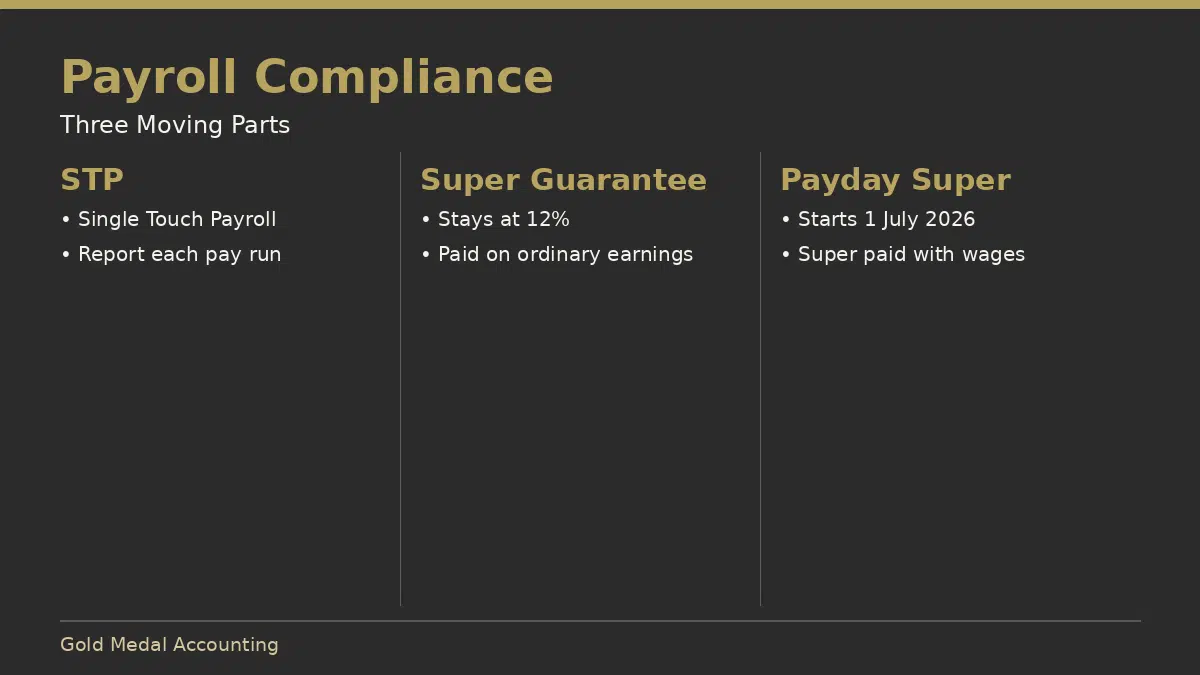
Payroll compliance has three moving parts for employers right now — Single Touch Payroll reporting, the standard 12% super guarantee, and a major change called Payday Super that took effect on 1 July 2026. If you employ staff on the Gold Coast, here’s what each of these actually requires of you.
Technical review by Lynn Witham, Senior Accountant, Director & Registered Tax Agent — last updated 19 September 2026.
Own or run a business on the Gold Coast?
We are a family-run accounting firm in Burleigh Waters. Book a business discovery meeting, a first conversation to see whether we are the right fit for your business. We confirm the scope and quote before we start.
Questions about this? Talk to Bradley Witham, Chief Financial Officer at Gold Medal Accounting.
Single Touch Payroll (STP)
STP requires you to report salary and wages, PAYG withholding and superannuation information to the ATO each time you run payroll, rather than only at the end of the year. Xero and most modern payroll software handle this reporting automatically as part of finalising a pay run, but the underlying pay items and super settings need to be configured correctly for the reported figures to be accurate.
Superannuation guarantee: what stays the same
The super guarantee rate remains 12%, but since 1 July 2026 it is calculated on qualifying earnings rather than ordinary time earnings. The bigger change is when and how you have to pay it.
Payday Super: the change that started on 1 July 2026
Since 1 July 2026, employers must pay super into an employee’s fund within 7 business days of payday, rather than under the old quarterly cycle (which allowed up to 28 days after each quarter ended). For the full picture, see our Payday Super guide. This is a significant tightening of the timeline — instead of a quarterly buffer, super becomes a near-immediate payroll obligation, much like PAYG withholding already is.
- Contributions must reach the fund within 7 business days of each payday, with limited exceptions for new employees.
- Contributions are calculated on “qualifying earnings,” a broader measure than ordinary time earnings that includes things like commissions and salary-sacrificed amounts.
- STP reporting expands to cover both qualifying earnings and the super liability itself, not just one or the other as it does now.
What employers should be doing now
The 7-day window leaves very little room for cash flow slack or administrative delay, so if you haven’t already, review your payroll process now, confirming your payroll software and clearing house can process super that quickly, and building super into your regular cash flow planning rather than treating it as a quarterly lump sum. We’re helping clients sort this out now. For the full detail, see our Payday Super guide. See the ATO’s official guidance on Payday Super for employers for the full compliance timeline.
Want help getting your payroll ready for Payday Super? Get in touch or call us on 07 5669 8922 — or read more about our payroll compliance services, part of our wider business accounting services on the Gold Coast.
Gold Medal Accounting is a family-run Gold Coast accountant in Burleigh Waters, helping individuals and businesses with tax, BAS and advice.