
Running a company brings a set of ongoing ASIC and legal obligations that don’t get much attention until something’s missed — a lapsed annual review, an out-of-date registered address, or a solvency resolution nobody thought to pass. None of these are complicated on their own, but they’re easy to overlook without a checklist to work from.
Technical review by Lynn Witham, Senior Accountant, Director & Registered Tax Agent — last updated 19 September 2026.
Own or run a business on the Gold Coast?
We are a family-run accounting firm in Burleigh Waters. Book a business discovery meeting, a first conversation to see whether we are the right fit for your business. We confirm the scope and quote before we start.
Questions about this? Talk to Bradley Witham, Chief Financial Officer at Gold Medal Accounting.
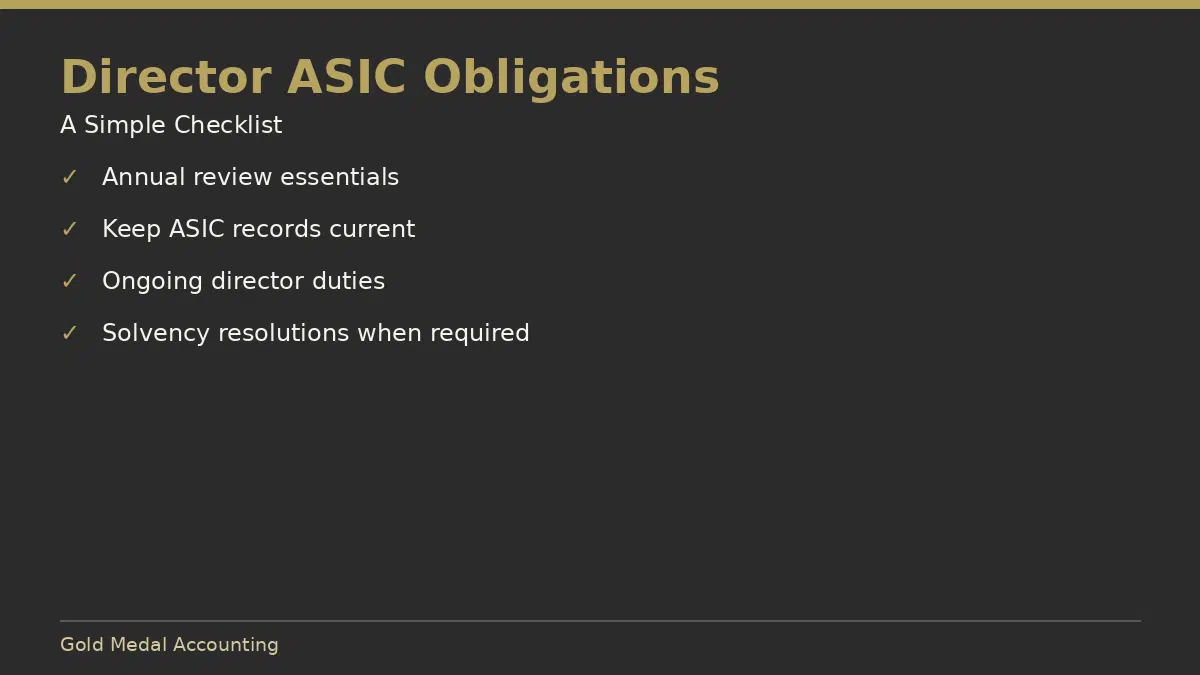
Annual review essentials
- Confirm your company details — ASIC sends a statement around your review date (your company’s registration anniversary); check it and update anything that’s changed.
- Pay the annual review fee — currently $342 for a standard proprietary company, due within two months of your review date. Miss it and late fees apply ($102 within a month overdue, $428 beyond that).
- Pass a solvency resolution — directors need to formally resolve that the company can pay its debts as and when they fall due, also within two months of the review date.
Keeping ASIC records current
- Registered office and principal place of business addresses
- Officeholder details — directors, secretaries, and their residential addresses
- Share structure and shareholder details after any changes
- Director identification numbers for any newly appointed directors
Ongoing director duties
Beyond the annual paperwork, ASIC expects directors to actively meet a set of ongoing duties: exercising care and diligence by staying across the company’s financial position, acting in good faith and in the company’s best interests, keeping company information confidential, maintaining proper financial records, and watching for signs of insolvency so the company doesn’t keep trading while unable to pay its debts. These aren’t one-off tasks — they’re expected to be attended to continuously, not just at annual review time.
Records, audits and growing companies
Companies must keep financial records that explain their transactions and financial position, and keep them for at least seven years. Good records matter for ASIC, for tax, and for any future sale or due diligence.
Most small proprietary companies do not need an audit. Large proprietary companies, measured against ASIC’s revenue, asset and employee thresholds, have extra obligations including audited financial statements, so it is worth checking where your company sits as it grows.
A simple way to stay on top of it
Most directors don’t fall behind because the obligations are difficult — they fall behind because there’s no one keeping track of the dates. We manage the annual review calendar for our company clients, flag anything that needs a director resolution, and keep an eye on the financial warning signs so insolvent trading risk gets raised early, not after the fact. For the official list of director obligations, see ASIC’s guide to company officeholder duties.
Want us to manage your company’s ASIC compliance calendar? Get in touch or call us on 07 5669 8922 — or read more about our ASIC compliance and company secretarial services, part of our wider business accounting services on the Gold Coast.
Want this handled for you? See our ASIC compliance services for Gold Coast companies.
Based in Burleigh Waters, Gold Medal Accounting is a family-run firm of Gold Coast accountants for individuals, property investors and businesses.