
Choosing how to structure your business is one of the first big decisions you’ll make — and one of the most consequential. It affects how much tax you pay, whether your personal assets are at risk, and how much paperwork you’re signing up for. Here’s a plain-English look at the three most common structures for Gold Coast businesses: sole trader, company and trust.
Technical review by Lynn Witham, Senior Accountant, Director & Registered Tax Agent — last updated 19 September 2026.
Own or run a business on the Gold Coast?
We are a family-run accounting firm in Burleigh Waters. Book a business discovery meeting, a first conversation to see whether we are the right fit for your business. We confirm the scope and quote before we start.
Questions about this? Talk to Bradley Witham, Chief Financial Officer at Gold Medal Accounting.
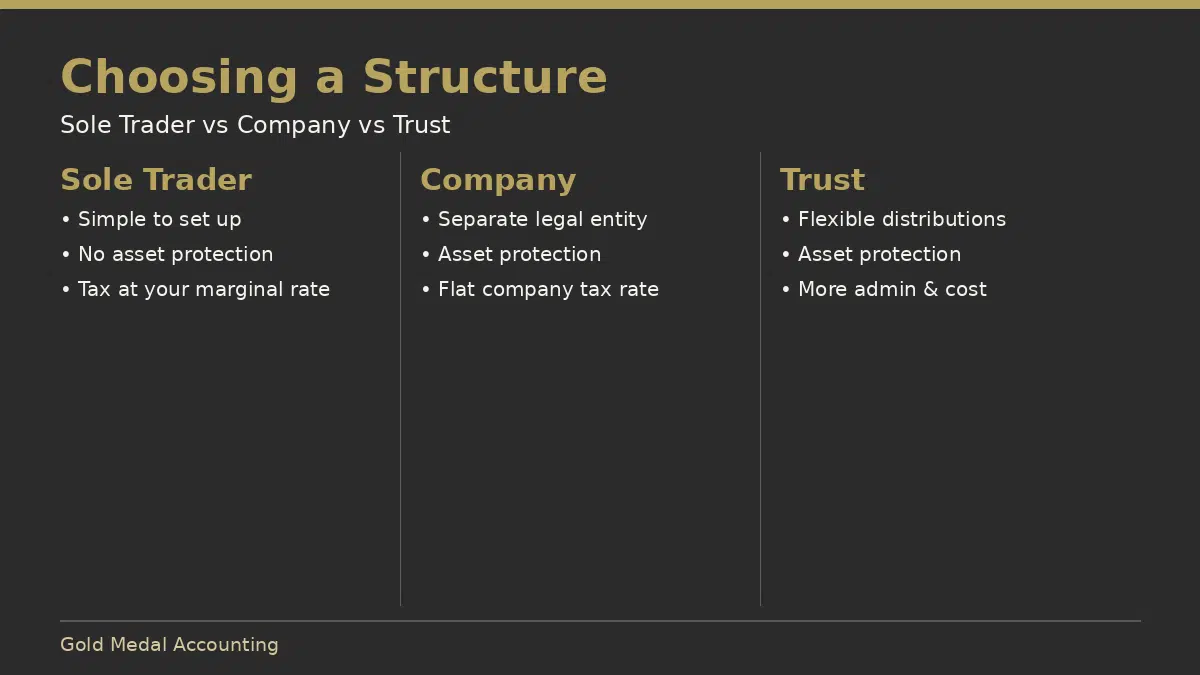
Sole trader
As a sole trader, you and the business are legally the same person. It’s the simplest and cheapest structure to set up, and your business income is taxed at your individual marginal tax rates through your personal tax return.
The trade-off: there’s no separation between you and the business, so your personal assets — your house, your car, your savings — aren’t protected if the business runs into debt or gets sued. It also gets harder to bring in a business partner or investor down the track.
Company
A company is a separate legal entity — it owns the business, and you own shares in it. That separation gives you limited liability in most circumstances, meaning your personal assets are generally protected from the company’s debts. Eligible small and medium businesses (“base rate entities”) currently pay a flat 25% company tax rate, compared to 30% for larger companies — rates worth confirming with us each year, since thresholds can change.
The trade-off: companies cost more to set up and run, with ASIC fees, annual reviews and more involved accounting. Profits sit inside the company until you draw them out as dividends, and losses can’t be passed through to your personal tax return.
Trust
A discretionary (family) trust holds and operates the business for the benefit of a group of beneficiaries, with a trustee — often a company — in control. The big attraction is flexibility: each year, the trustee can decide how income is distributed among beneficiaries, which is useful for spreading income across a family in a tax-effective way. Trusts can also offer asset protection benefits, depending on how they’re set up.
The trade-off: trusts are more complex and costly to establish and run, with a trust deed and ongoing trustee obligations. Losses stay trapped in the trust rather than flowing through to beneficiaries, and the ATO has been paying closer attention to how trust distributions are made in recent years — another reason to get the paperwork right from the start.
Which structure is right for your business?
There’s no single right answer — it depends on how much liability protection you need, how much profit you’re reinvesting versus drawing out, whether you want to involve family members or other owners, and how much compliance cost and admin you’re prepared to take on. Plenty of businesses start as a sole trader and move to a company or trust structure once profits grow or the risk profile changes. The ATO’s guide to choosing a business structure is a useful starting point for comparing the tax treatment of each option.
This is general information, not advice tailored to your circumstances — the right structure depends on your specific situation. If you’d like to talk through what makes sense for your business, get in touch with Gold Medal Accounting or call us on 07 5669 8922. You can also read more about our business accounting services.
Based in Burleigh Waters, Gold Medal Accounting is a family-run firm of Gold Coast accountants for individuals, property investors and businesses.